



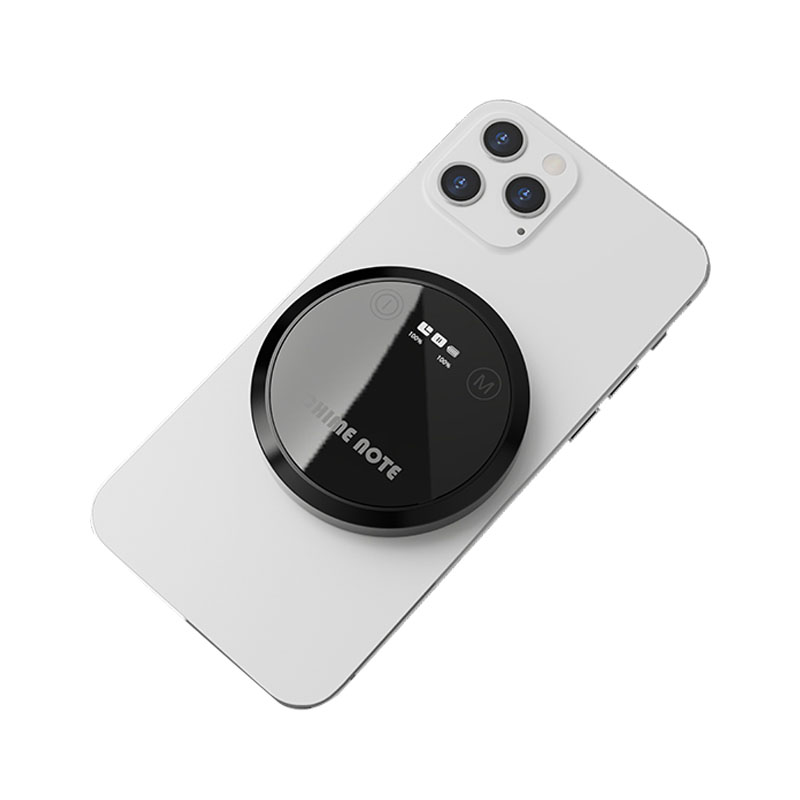


In noisy environments, how does an AI voice recorder intelligently distinguish between target speech and background noise?
Release Time : 2026-01-28
In noisy environments, AI voice recorders need an intelligent technology system that integrates sound source separation, environmental perception, and dynamic adaptation to accurately distinguish target speech from interference. Its core logic is not simply "filtering noise," but rather constructing a "precise recognition model" for target speech by analyzing the physical characteristics, semantic information, and spatial distribution of sound from multiple dimensions. This process encompasses four main stages: sound acquisition, feature extraction, sound source separation, and dynamic optimization, each relying on deep collaboration between AI algorithms and hardware.
In the sound acquisition stage, the AI voice recorder constructs a "spatial auditory system" using a multi-microphone array. Unlike traditional single microphones, each microphone in the array captures sound waves from different angles, recording the time difference, intensity difference, and phase difference of sound arrival. For example, when the target speech comes from directly in front, the main microphone receives the strongest signal, while the side microphones primarily capture ambient noise. By analyzing these differences, the AI algorithm can initially locate the direction of the sound source, providing spatial coordinates for subsequent separation. Some high-end devices also incorporate beamforming technology, adjusting the weighting coefficients of the microphone array to form a "virtual beam" pointing towards the target sound source, further suppressing side interference.
In the feature extraction stage, AI needs to extract the "unique identifier" of the target speech from the mixed sound. Speech signals are time-varying and non-stationary; their frequency, amplitude, harmonic structure, and other features change dynamically with the content of the speech. AI uses short-time Fourier transform to convert the sound into a time-spectrum graph, analyzing the energy distribution of different frequency components in the frequency domain. For example, the fundamental frequency of human voice is typically concentrated in the 85Hz-255Hz range (male) or 165Hz-500Hz range (female), while the energy of high-frequency noise (such as fan noise) is concentrated in higher frequency bands. Furthermore, AI extracts Mel-frequency cepstral coefficients (MFCCs) to simulate the human ear's perception of sound, enhancing the capture of key features such as speech formants and consonant bursts. These features collectively constitute the "digital fingerprint" of the target speech, providing a basis for sound source separation.
Sound source separation is the core challenge; AI needs to "deconstruct" the target speech from the mixed signal. Traditional methods such as Independent Component Analysis (ICA) assume that sound sources are statistically independent and separate signals through linear transformation, but their effectiveness is limited in complex environments. Current mainstream solutions employ deep learning models, such as Convolutional Recurrent Neural Networks (CRNNs) or Transformer architectures. These models are trained on massive amounts of data to learn the differential patterns of speech and noise in the time-frequency domain. For example, CRNNs combine the local feature extraction capabilities of convolutional layers with the temporal modeling capabilities of recurrent layers to accurately identify the spectral continuity of speech (such as the continuous vibration of vowels) and the randomness of noise (such as sudden impulses from keyboard clicks). After separation, the AI generates an "Ideal Proportion Mask" (IRM) that marks the proportion of the target speech in each time-frequency unit, and finally recovers the clean speech by multiplying the mask by the mixed signal.
Dynamic optimization mechanisms ensure that the AI can adapt to environmental changes. In real-world scenarios, the type of noise (such as a sudden door slam), its intensity (such as changes in air conditioner fan speed), and the state of the target speech (such as speaker movement) all change dynamically. The AI dynamically adjusts its separation strategy by monitoring the feature distribution of the input signal in real time. For example, when sudden noise is detected, the system temporarily increases the weight of the transient suppression module to quickly reduce the noise energy during that period. When the speaker turns around, causing a change in the direction of the sound source, the microphone array recalculates the beamforming coefficients to ensure focusing accuracy. Some devices also introduce feedback mechanisms to compare the separated speech with the original signal, continuously optimizing model parameters.
The integration of semantic understanding technology further improves separation accuracy. Traditional methods rely solely on the physical characteristics of sound, while AI voice recorders can combine speech recognition models with contextual semantic assistance for judgment. For example, when a separated speech segment contains complete words or sentences, the system can confirm it as the target speech; if the segment contains meaningless syllables or matches a known noise pattern, it may be classified as interference. This "acoustic-semantic" joint decision-making mechanism effectively solves the misjudgment problem of traditional methods in low signal-to-noise ratio scenarios.
The collaborative optimization of hardware and algorithms is key to the practical application of the technology. The physical design of the microphone array (such as microphone spacing and number) directly affects the ability to capture spatial information; the computing power of the chip determines the model's inference speed and real-time performance. For example, edge computing devices need to run lightweight models under low power consumption, while cloud processing can support more complex deep learning architectures. Furthermore, signal latency during noise reduction needs to be controlled within milliseconds to avoid audio-video synchronization issues, posing a dual challenge to both hardware transmission speed and algorithm efficiency.
From an application perspective, the technological value of AI voice recorders has permeated multiple fields. In online meetings, the system can eliminate keyboard noise and air conditioning noise, ensuring the speaker's voice is clear; in intelligent customer service scenarios, the device can accurately identify the user's needs even in noisy environments; in medical records, the doctor's voice in the examination room can be accurately separated, avoiding interference from the patient's cough. With technological iteration, future AI voice recorders will further integrate functions such as emotion recognition and multilingual support, achieving a more intelligent interactive experience in complex acoustic environments.