




How does the dual Bluetooth synchronization mechanism between the app and the device ensure the real-time performance and accuracy of the AI voice recorder?
Release Time : 2026-02-11
In today's rapidly developing smart voice devices, the AI voice recorder has evolved from a simple recording tool into a highly efficient productivity terminal integrating acquisition, processing, transcription, and intelligent analysis. Its core competitiveness lies not only in hardware performance but also in the deep collaboration between the device and the mobile app. In particular, the "dual Bluetooth" architecture provides the technological foundation for achieving low-latency, high-fidelity, and high-accuracy voice processing.
1. Dual-Channel Division of Labor: Audio Stream and Control Stream Operate in Parallel
Traditional single Bluetooth solutions require bandwidth sharing between audio transmission and command interaction, easily causing stuttering or latency. The AI voice recorder, however, uses a dual Bluetooth synchronization design, splitting the task into two independent channels: Classic Bluetooth is dedicated to high-quality audio stream transmission, ensuring lossless transmission of the original voice to the phone at a sampling rate of 44.1kHz or higher; Low Energy Bluetooth is responsible for transmitting control commands, status information, and metadata. This "audio-control separation" architecture avoids resource contention, ensuring audio transmission is not interfered with by background operations, significantly improving real-time smoothness.
2. Edge-Cloud Collaborative Processing for Optimized Transcription Accuracy
The recorder's built-in AI noise reduction chip performs front-end processing on the raw audio, then synchronizes the optimized clean audio stream to the app via Bluetooth. The app then calls a local or cloud-based ASR engine for transcription. Thanks to the stable connection of dual Bluetooth devices, audio and timestamp data can be aligned at the millisecond level, ensuring strict synchronization between transcribed text and speech. Simultaneously, the app can combine a contextual semantic model to correct errors, segment, and restore punctuation in the initial transcription results, significantly improving the recognition accuracy of over 120 languages, especially in multi-speaker scenarios such as meetings and interviews.
3. Low-Latency Protocol and Buffer Optimization for Real-Time Experience
To achieve real-time feedback for "record and display simultaneously," the system employs an adaptive buffering strategy: the BLE channel reports the recording status at 10ms intervals, and the app dynamically adjusts the audio receiving buffer size accordingly, avoiding playback interruptions or latency build-up due to network jitter. Meanwhile, Bluetooth 5.0 and above support higher throughput and lower power consumption, and with a customized communication protocol, end-to-end latency is controlled within 200ms. Users can almost simultaneously see the speech-to-text process on their phone screen, greatly enhancing the naturalness of the interaction and user confidence.
4. Dual-End Data Verification and Resume Transmission Mechanism
In complex electromagnetic environments or mobile scenarios, Bluetooth connections may fluctuate briefly. To address this, the AI voice recorder and the app establish a two-way heartbeat mechanism to monitor link quality in real time. Once packet loss is detected, the app immediately requests the device to retransmit key audio frames; if the connection is interrupted, the device automatically caches the untransmitted data and seamlessly resumes transmission upon recovery. Furthermore, 64GB of local storage acts as a "double insurance," ensuring that even if Bluetooth completely fails, the original recording is completely preserved and can be exported directly via Type-C, eliminating the risk of data loss.
5. Cross-Platform Compatibility and Secure Synchronization
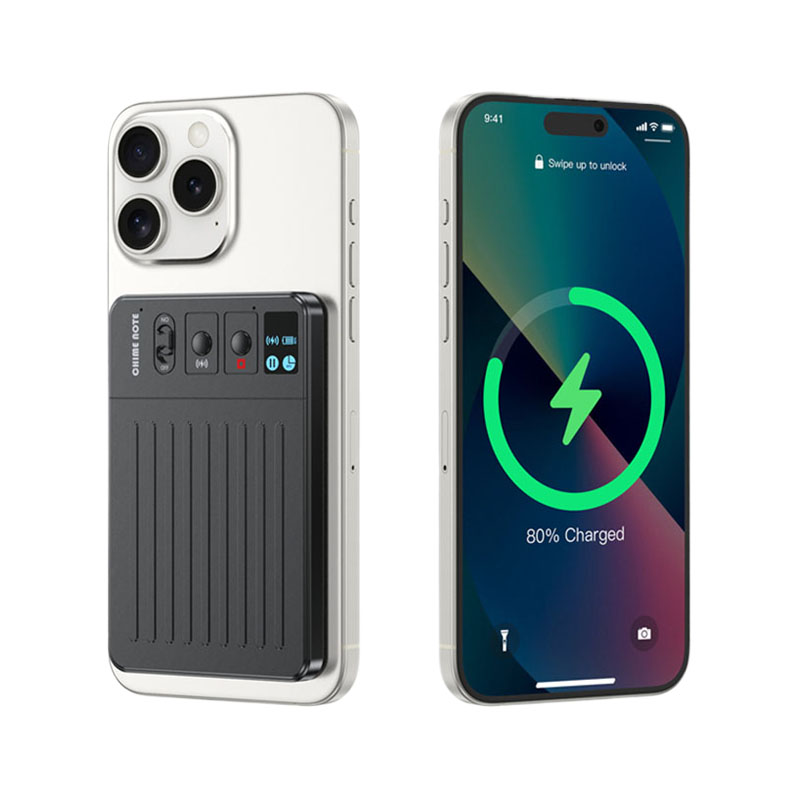
This collaborative mechanism fully supports iOS, Android, and Web platforms. Regardless of the user's device, the app can establish a secure pairing with the recorder through a unified API. All voice and text data are encrypted using AES-256 during transmission and support local storage or encrypted upload to Google servers, ensuring both privacy and seamless access across multiple devices. Notes edited on a user's phone or mind maps generated can be synced back to the device's OLED screen for display, forming a closed-loop workflow.
The collaboration between the dual Bluetooth sync app and the AI voice recorder is not merely an aggregation of wireless connectivity technologies, but a deep integration of hardware and software in an intelligent systems engineering project. Through four pillars—channel separation, edge intelligence, low-latency optimization, and secure synchronization—it successfully resolves the traditional contradiction between real-time performance and accuracy, allowing voice to move from being "recorded" to being "understood." In today's increasingly globalized and mobile-driven work environment, this mechanism is becoming a key enabler of efficient communication and knowledge management.
1. Dual-Channel Division of Labor: Audio Stream and Control Stream Operate in Parallel
Traditional single Bluetooth solutions require bandwidth sharing between audio transmission and command interaction, easily causing stuttering or latency. The AI voice recorder, however, uses a dual Bluetooth synchronization design, splitting the task into two independent channels: Classic Bluetooth is dedicated to high-quality audio stream transmission, ensuring lossless transmission of the original voice to the phone at a sampling rate of 44.1kHz or higher; Low Energy Bluetooth is responsible for transmitting control commands, status information, and metadata. This "audio-control separation" architecture avoids resource contention, ensuring audio transmission is not interfered with by background operations, significantly improving real-time smoothness.
2. Edge-Cloud Collaborative Processing for Optimized Transcription Accuracy
The recorder's built-in AI noise reduction chip performs front-end processing on the raw audio, then synchronizes the optimized clean audio stream to the app via Bluetooth. The app then calls a local or cloud-based ASR engine for transcription. Thanks to the stable connection of dual Bluetooth devices, audio and timestamp data can be aligned at the millisecond level, ensuring strict synchronization between transcribed text and speech. Simultaneously, the app can combine a contextual semantic model to correct errors, segment, and restore punctuation in the initial transcription results, significantly improving the recognition accuracy of over 120 languages, especially in multi-speaker scenarios such as meetings and interviews.
3. Low-Latency Protocol and Buffer Optimization for Real-Time Experience
To achieve real-time feedback for "record and display simultaneously," the system employs an adaptive buffering strategy: the BLE channel reports the recording status at 10ms intervals, and the app dynamically adjusts the audio receiving buffer size accordingly, avoiding playback interruptions or latency build-up due to network jitter. Meanwhile, Bluetooth 5.0 and above support higher throughput and lower power consumption, and with a customized communication protocol, end-to-end latency is controlled within 200ms. Users can almost simultaneously see the speech-to-text process on their phone screen, greatly enhancing the naturalness of the interaction and user confidence.
4. Dual-End Data Verification and Resume Transmission Mechanism
In complex electromagnetic environments or mobile scenarios, Bluetooth connections may fluctuate briefly. To address this, the AI voice recorder and the app establish a two-way heartbeat mechanism to monitor link quality in real time. Once packet loss is detected, the app immediately requests the device to retransmit key audio frames; if the connection is interrupted, the device automatically caches the untransmitted data and seamlessly resumes transmission upon recovery. Furthermore, 64GB of local storage acts as a "double insurance," ensuring that even if Bluetooth completely fails, the original recording is completely preserved and can be exported directly via Type-C, eliminating the risk of data loss.
5. Cross-Platform Compatibility and Secure Synchronization
This collaborative mechanism fully supports iOS, Android, and Web platforms. Regardless of the user's device, the app can establish a secure pairing with the recorder through a unified API. All voice and text data are encrypted using AES-256 during transmission and support local storage or encrypted upload to Google servers, ensuring both privacy and seamless access across multiple devices. Notes edited on a user's phone or mind maps generated can be synced back to the device's OLED screen for display, forming a closed-loop workflow.
The collaboration between the dual Bluetooth sync app and the AI voice recorder is not merely an aggregation of wireless connectivity technologies, but a deep integration of hardware and software in an intelligent systems engineering project. Through four pillars—channel separation, edge intelligence, low-latency optimization, and secure synchronization—it successfully resolves the traditional contradiction between real-time performance and accuracy, allowing voice to move from being "recorded" to being "understood." In today's increasingly globalized and mobile-driven work environment, this mechanism is becoming a key enabler of efficient communication and knowledge management.