




How does an AI voice recorder achieve real-time speech transcription and automatic speaker differentiation?
Release Time : 2026-02-20
In today's era of rapid development in artificial intelligence and voice technology, AI voice recorders have evolved from traditional "sound recording tools" into highly efficient productivity devices integrating intelligent recognition, multilingual processing, and content extraction. Real-time speech transcription and automatic speaker differentiation are its core intelligent functions, greatly improving work efficiency in scenarios such as meeting minutes, interview transcription, and classroom note-taking. This capability, combined with its hardware configuration and software ecosystem, relies on the deep integration of acoustic modeling, deep learning algorithms, and edge computing.
1. Dual Microphone Array and AI Noise Reduction: The Foundation of High-Quality Audio Input
The AI voice recorder incorporates dual marker microphones to form a directional microphone array, accurately capturing sound sources in front while suppressing ambient noise. Combined with a dedicated AI chip for real-time noise reduction, it effectively filters out interference such as air conditioning noise, keyboard typing, and traffic noise, ensuring clear and pure recorded speech. High-quality original audio is a prerequisite for subsequent speech recognition and speaker differentiation—if the input signal is mixed and distorted, even the most advanced algorithms will struggle to accurately reproduce the content. Therefore, acoustic optimization at the hardware level constitutes the "first line of defense" for intelligent transcription.
2. Edge-Cloud Collaborative Speech Recognition Engine: Supporting Real-Time Transcription of 120+ Languages
The recorder connects to a dedicated app via dual Bluetooth connections, transmitting the collected audio stream to the cloud or local speech recognition engine in real time. Leveraging deep neural networks and the Transformer architecture, the system can convert speech into text within milliseconds and supports languages and dialects from over 120 countries and regions. More importantly, this process is not simply "listening and writing," but rather dynamically corrects based on contextual semantics, significantly improving the accuracy of recognizing error-prone content such as technical terms, numbers, and names. This high-precision transcription provides a reliable text foundation for multi-speaker differentiation.
3. Voiceprint Feature Extraction and Clustering: Achieving Intelligent Separation of "Who is Saying What"
The core of multi-speaker differentiation lies in "voiceprint recognition" and "speaker clustering." The AI system first extracts the acoustic features of each speaker from the speech stream, forming a unique "voiceprint vector." Subsequently, using an unsupervised clustering algorithm, speech segments with similar voiceprint features are grouped into the same category and automatically labeled as "Speaker A," "Speaker B," etc. Even with multiple speakers or fast speaking speeds, the advanced model can achieve high-precision separation through timestamp alignment and contextual reasoning. Users can see role-based, timeline-based dialogue texts directly within the app, greatly simplifying post-processing.
4. Deep Integration with ChatGPT 4o: A Leap from Transcription to Intelligent Summarization
Unlike ordinary recording devices, this AI voice recorder further integrates with ChatGPT 4o, allowing transcribed text to be directly input into the large language model. The system can automatically identify dialogue topics, generate structured summaries, action lists, and even output visual mind maps. For example, in business meetings, it can not only distinguish the content of each speaker but also extract key information such as "decision points," "to-do items," and "points of contention," truly achieving "recording as output." This feature, being the world's first permanently free and open feature, significantly lowers the barrier to entry for professional-grade voice intelligence.
5. Safe, Portable, and Long Battery Life: Ensuring Reliable Operation Around the Clock
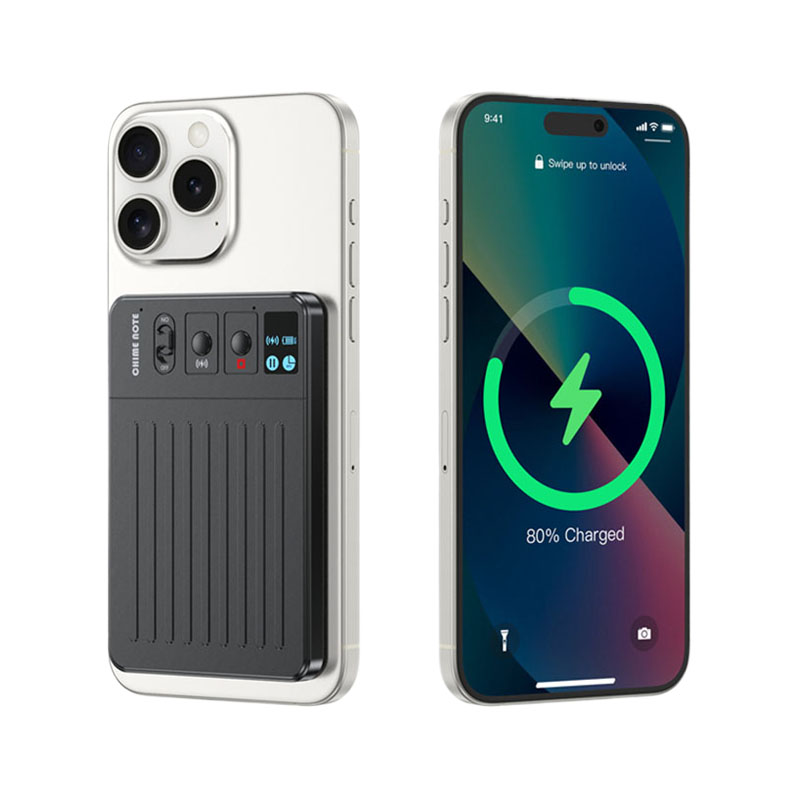
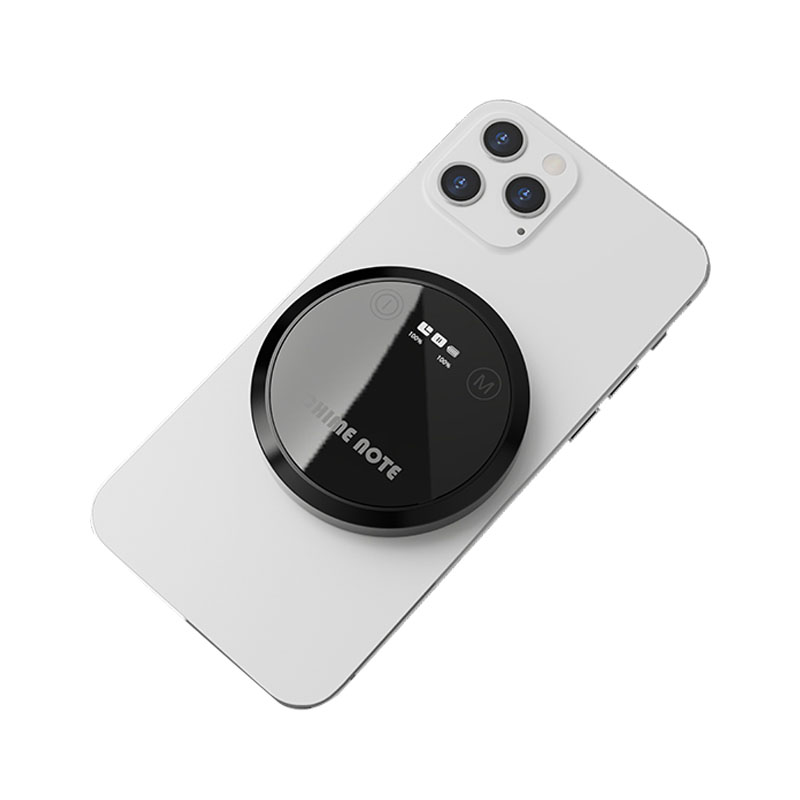
To support intensive use, the device is equipped with a 3000mAh battery, supporting over 80 hours of continuous recording and can also be used as a magnetic power bank for reverse charging; 64GB of internal memory meets the storage needs of thousands of hours; a 0.5-inch OLED screen displays the status in real time, avoiding privacy disputes caused by accidental operation; all audio and text support end-to-end encryption, with options for local or cloud secure storage. Its slim and lightweight body and magnetic design allow it to seamlessly attach to a phone or laptop, enabling intelligent recording anytime, anywhere.
The AI voice recorder's ability to achieve "real-time transcription + multi-speaker differentiation" is the result of the collaborative evolution of hardware sensing, edge AI, cloud-based large-scale models, and security architecture. It is no longer just an extension of the ear, but an assistant to the brain—transforming noisy sound streams into clear, structured, and actionable knowledge assets, truly empowering the efficient operation of modern workplaces, education, and cross-cultural communication.
1. Dual Microphone Array and AI Noise Reduction: The Foundation of High-Quality Audio Input
The AI voice recorder incorporates dual marker microphones to form a directional microphone array, accurately capturing sound sources in front while suppressing ambient noise. Combined with a dedicated AI chip for real-time noise reduction, it effectively filters out interference such as air conditioning noise, keyboard typing, and traffic noise, ensuring clear and pure recorded speech. High-quality original audio is a prerequisite for subsequent speech recognition and speaker differentiation—if the input signal is mixed and distorted, even the most advanced algorithms will struggle to accurately reproduce the content. Therefore, acoustic optimization at the hardware level constitutes the "first line of defense" for intelligent transcription.
2. Edge-Cloud Collaborative Speech Recognition Engine: Supporting Real-Time Transcription of 120+ Languages
The recorder connects to a dedicated app via dual Bluetooth connections, transmitting the collected audio stream to the cloud or local speech recognition engine in real time. Leveraging deep neural networks and the Transformer architecture, the system can convert speech into text within milliseconds and supports languages and dialects from over 120 countries and regions. More importantly, this process is not simply "listening and writing," but rather dynamically corrects based on contextual semantics, significantly improving the accuracy of recognizing error-prone content such as technical terms, numbers, and names. This high-precision transcription provides a reliable text foundation for multi-speaker differentiation.
3. Voiceprint Feature Extraction and Clustering: Achieving Intelligent Separation of "Who is Saying What"
The core of multi-speaker differentiation lies in "voiceprint recognition" and "speaker clustering." The AI system first extracts the acoustic features of each speaker from the speech stream, forming a unique "voiceprint vector." Subsequently, using an unsupervised clustering algorithm, speech segments with similar voiceprint features are grouped into the same category and automatically labeled as "Speaker A," "Speaker B," etc. Even with multiple speakers or fast speaking speeds, the advanced model can achieve high-precision separation through timestamp alignment and contextual reasoning. Users can see role-based, timeline-based dialogue texts directly within the app, greatly simplifying post-processing.
4. Deep Integration with ChatGPT 4o: A Leap from Transcription to Intelligent Summarization
Unlike ordinary recording devices, this AI voice recorder further integrates with ChatGPT 4o, allowing transcribed text to be directly input into the large language model. The system can automatically identify dialogue topics, generate structured summaries, action lists, and even output visual mind maps. For example, in business meetings, it can not only distinguish the content of each speaker but also extract key information such as "decision points," "to-do items," and "points of contention," truly achieving "recording as output." This feature, being the world's first permanently free and open feature, significantly lowers the barrier to entry for professional-grade voice intelligence.
5. Safe, Portable, and Long Battery Life: Ensuring Reliable Operation Around the Clock
To support intensive use, the device is equipped with a 3000mAh battery, supporting over 80 hours of continuous recording and can also be used as a magnetic power bank for reverse charging; 64GB of internal memory meets the storage needs of thousands of hours; a 0.5-inch OLED screen displays the status in real time, avoiding privacy disputes caused by accidental operation; all audio and text support end-to-end encryption, with options for local or cloud secure storage. Its slim and lightweight body and magnetic design allow it to seamlessly attach to a phone or laptop, enabling intelligent recording anytime, anywhere.
The AI voice recorder's ability to achieve "real-time transcription + multi-speaker differentiation" is the result of the collaborative evolution of hardware sensing, edge AI, cloud-based large-scale models, and security architecture. It is no longer just an extension of the ear, but an assistant to the brain—transforming noisy sound streams into clear, structured, and actionable knowledge assets, truly empowering the efficient operation of modern workplaces, education, and cross-cultural communication.